Cut analyst turnaround from two weeks to under 24 hours
I led the end-to-end design of a new Request for Information (RFI) system that introduced AI-assisted intelligence requests using Strider's AI agent, Spark. RFIs that previously ran through customer success and manual analyst research now happen in-platform: a submission form with Spark-generated and analyst-assisted paths, an RFI manager dashboard, and individual RFI profile pages.
Overview
- •The Problem: intelligence requests took up to two weeks, outside the product
- •The Constraint: 60% of clients couldn't let AI process their investigation data
- •The Solution: one in-platform workflow with both Spark and analyst paths
- •The Design Choices: transparency, editability, and credit system states
- •The Outcome: turnaround under 24 hours and measurably higher AI adoption
Snapshot
14 days to under 24 hours
Analyst turnaround on a client request for information
45%
Less time spent creating a request, against the manual process
60% to 45%
Clients unwilling to let AI process their investigation data
12 interviews
Eight enterprise clients and four intelligence analysts, before any UI
The Problem
Strider's platform helps organizations investigate individuals and companies to identify geopolitical and corporate risks.
When a profile lacked sufficient intelligence, clients would request deeper research from Strider analysts. However, the process happened outside the product.
Original Workflow
- •Clients emailed or messaged the customer success team
- •Customer success relayed the request to intelligence analysts
- •Analysts conducted research manually
- •Reports were returned to the client
Turnaround time could take up to two weeks, and clients had no in-platform way to submit or track RFIs.
The Goal
Create an in-platform RFI system that would:
- •Allow clients to submit RFIs directly in the platform
- •Reduce manual effort in creating requests
- •Deliver intelligence significantly faster
- •Introduce Spark (AI) as an optional accelerated workflow
Discovery: Understanding How Clients Submit RFIs
Before designing the solution, I interviewed 8 enterprise clients and 4 internal intelligence analysts.
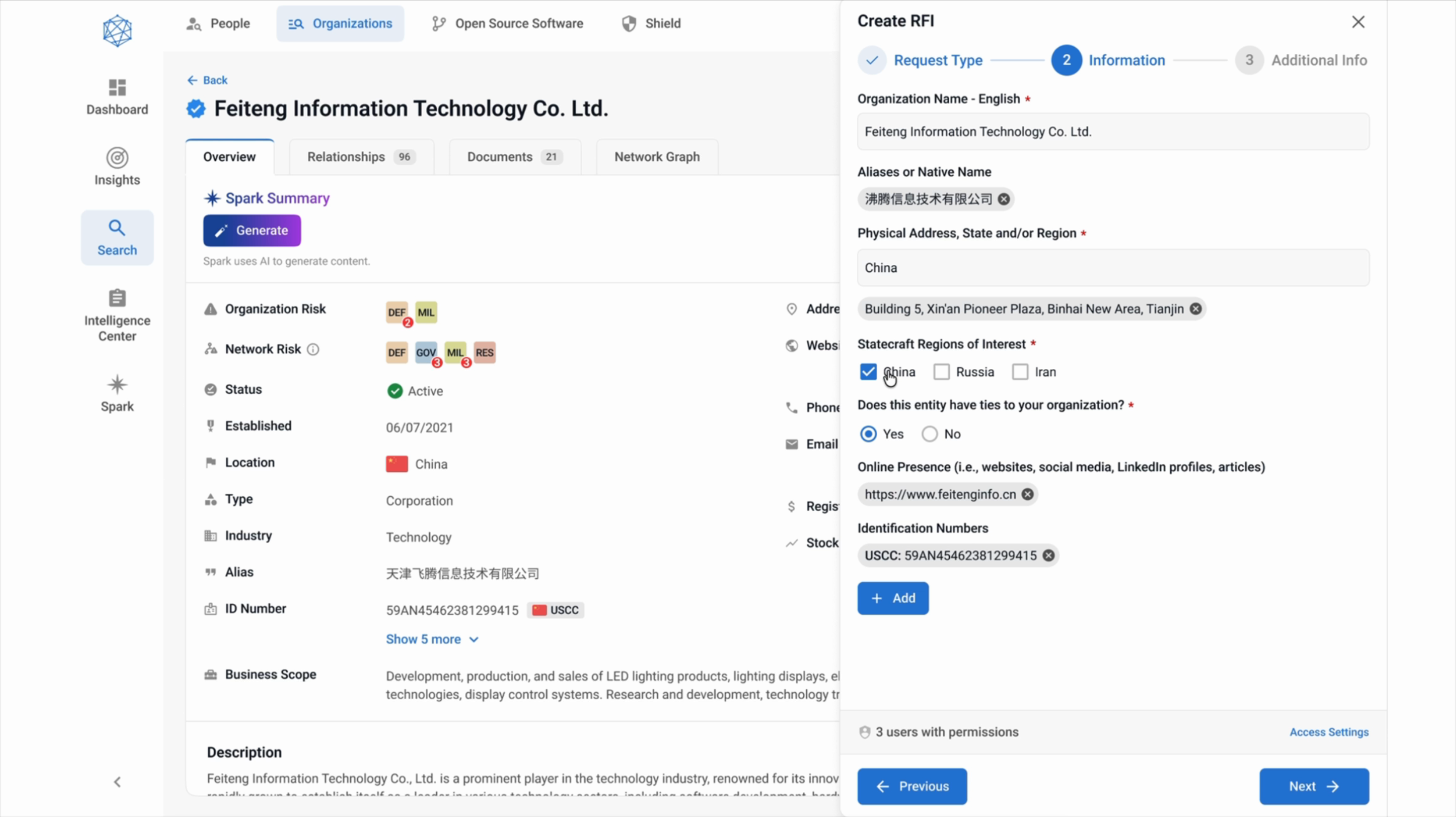
Key Insight: Clients frequently added external identifiers
Investigators often included information not present in the platform such as:
- •EIN / tax identification numbers
- •USCC identifiers for PRC entities
- •KPP identifiers for Russian entities
- •Internal company reference numbers
To support this, I expanded the RFI form to include structured identifier fields.
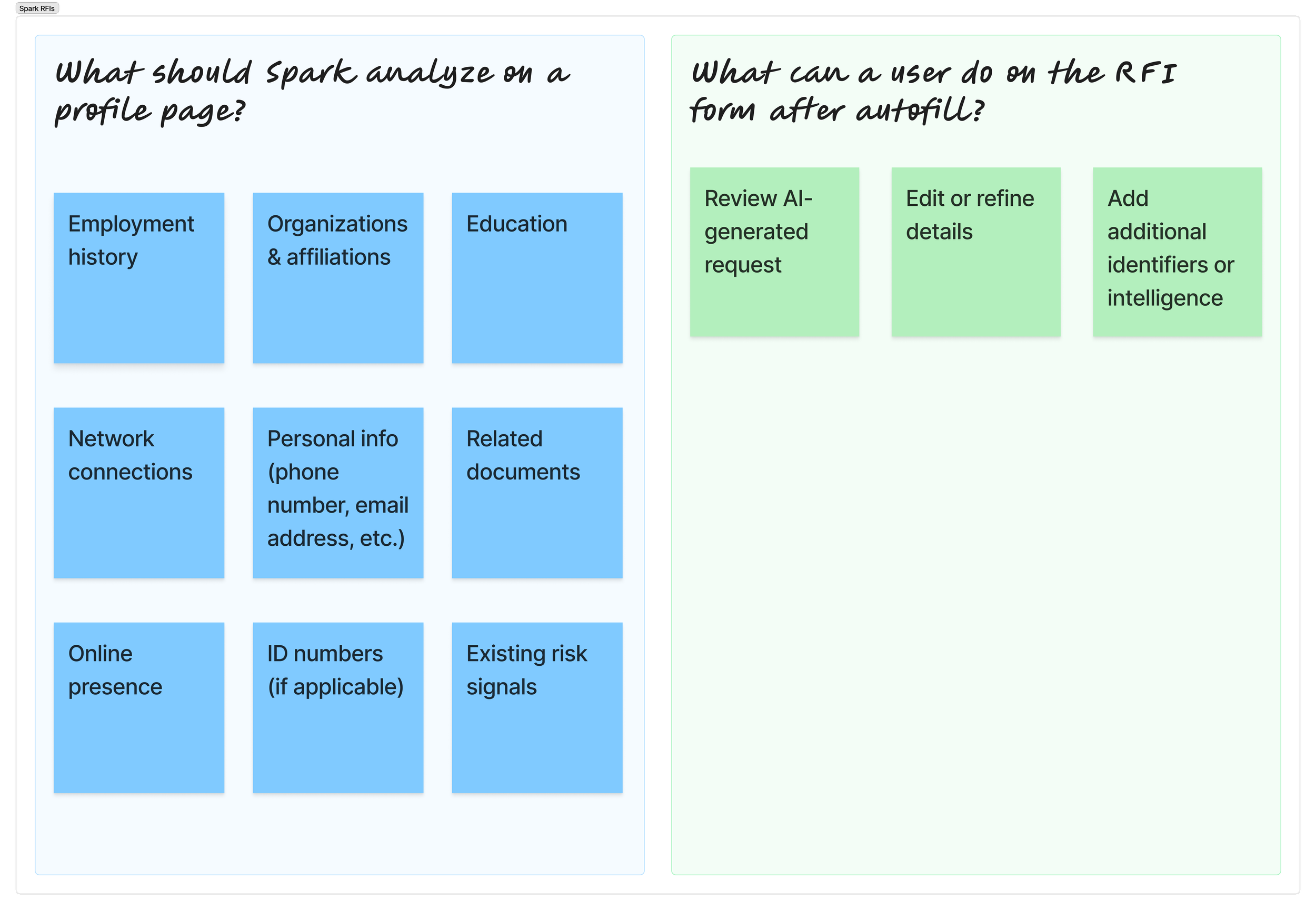
Users wanted faster insights but still needed control
Clients were interested in AI assistance but wanted to:
- •Review AI-generated requests
- •Add additional intelligence before submission
This shaped how we designed the Spark workflow, keeping the human in the loop on every request.
The Constraint
When the project began, about 60% of our clients were hesitant to use AI in their investigative workflows, largely because their companies wouldn't allow personal or private investigation data to be processed by AI. Strider's terms weren't changing, so the system had to make AI fully optional and transparent:
- •Clear labeling of Spark-generated RFIs
- •Editable AI-generated submissions
- •Visibility into estimated turnaround times
- •The ability to choose analyst-assisted RFIs
This allowed clients to gradually experiment with AI without bending their internal policies.
The Solution
Replacing the analyst workflow was never an option. It was the path AI-hesitant clients trusted, so the goal was to add speed alongside it, not take it away. The redesigned system introduced four major components.
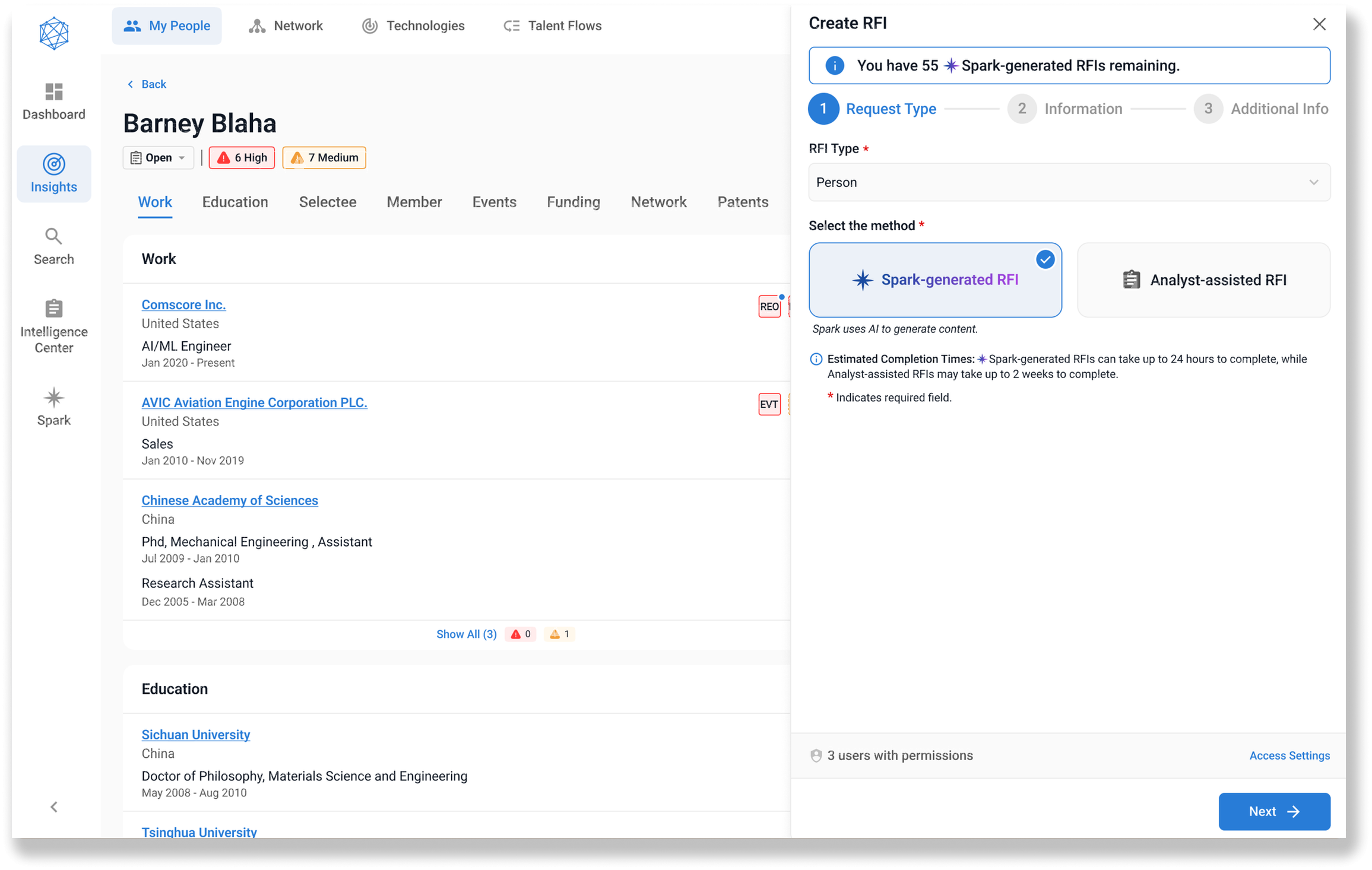
1. RFI Submission Form
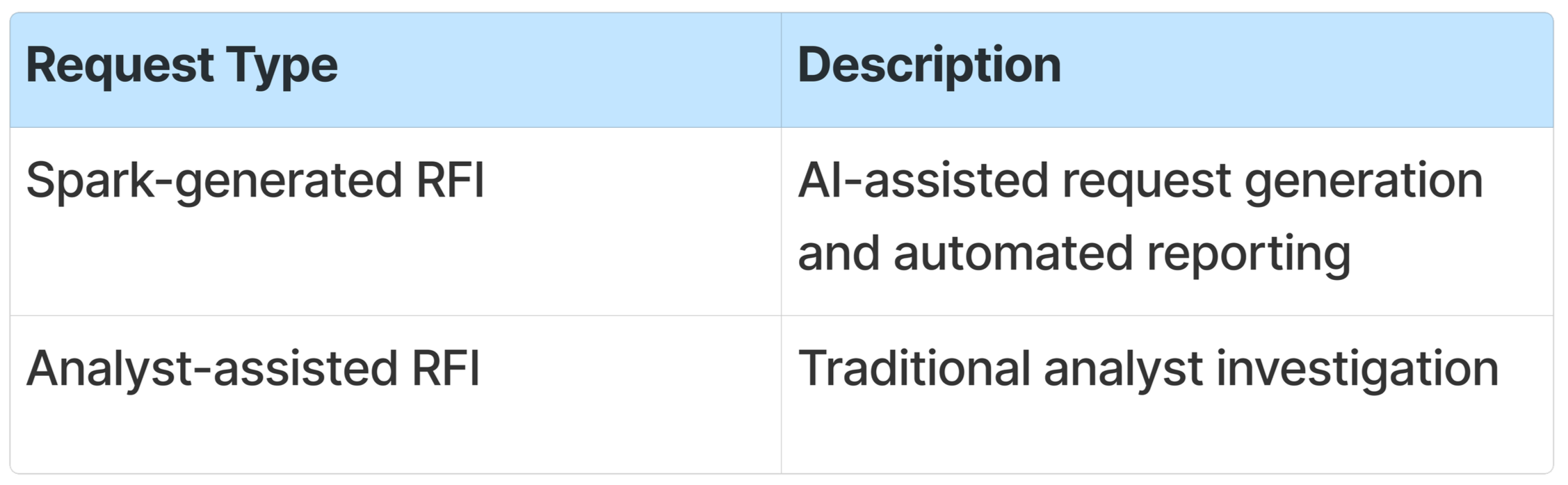
A new form allowed users to create requests directly within the platform. Users could choose between submissions generated by Spark or handled by an analyst. The form follows the platform's existing panel and stepper patterns, so creating an RFI feels native to the investigative workflow rather than a bolted-on experience.
2. Spark-generated RFIs
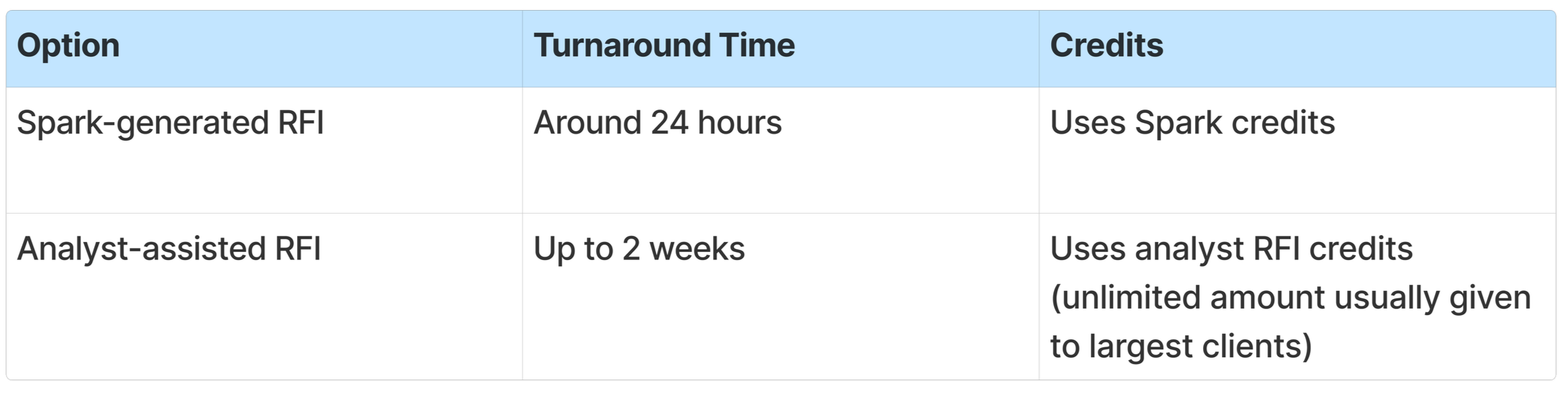
Once submitted, Spark generates a report and profile update within ~24 hours, compared to the previous two-week analyst turnaround.
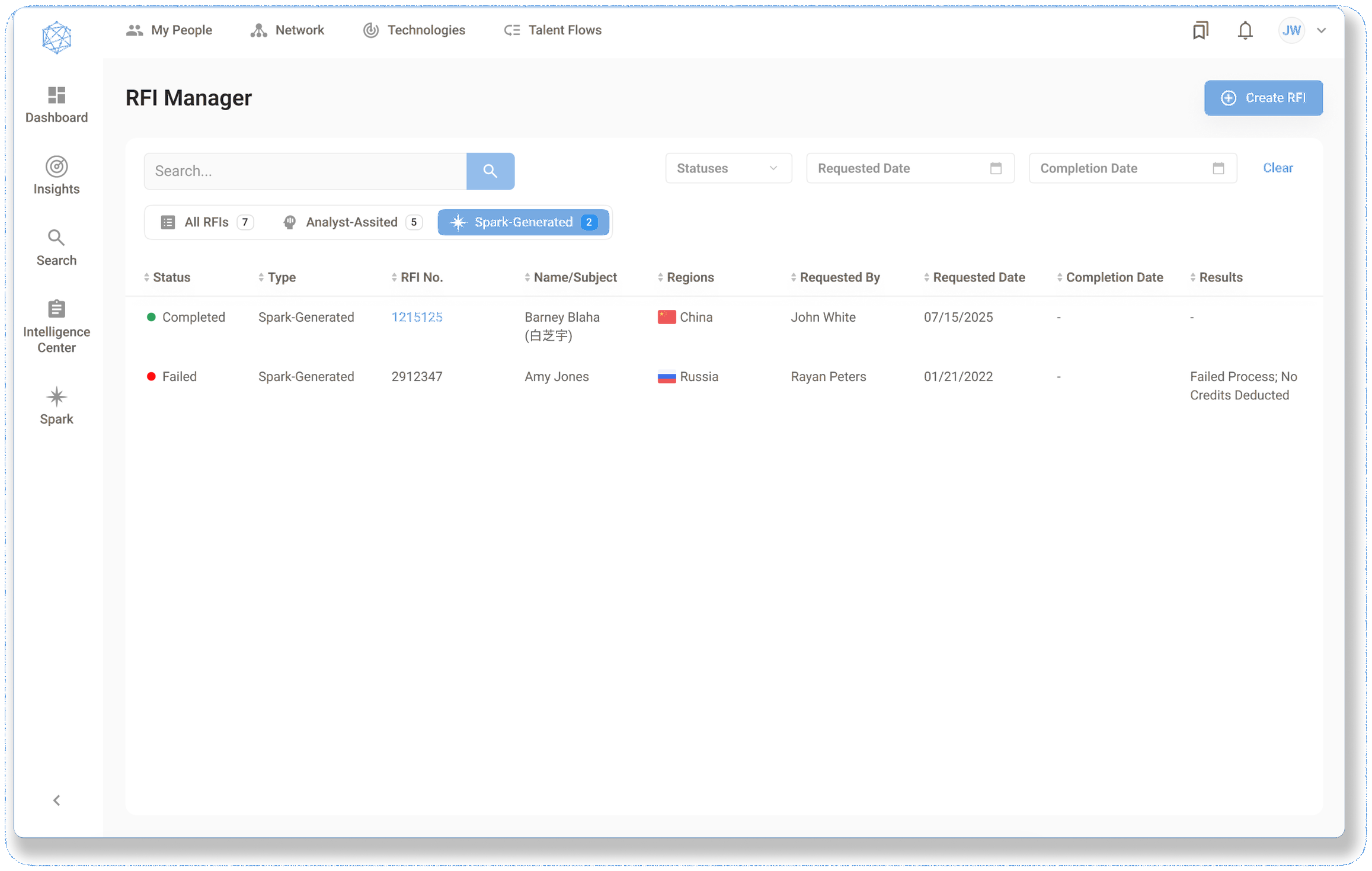
3. RFI Manager Dashboard
I designed an RFI Manager page where users could track all requests in one place. The dashboard allows users to:
- •View all RFIs submitted by their organization
- •See request status and progress
- •Quickly access individual RFI pages
This gave clients visibility that previously did not exist.
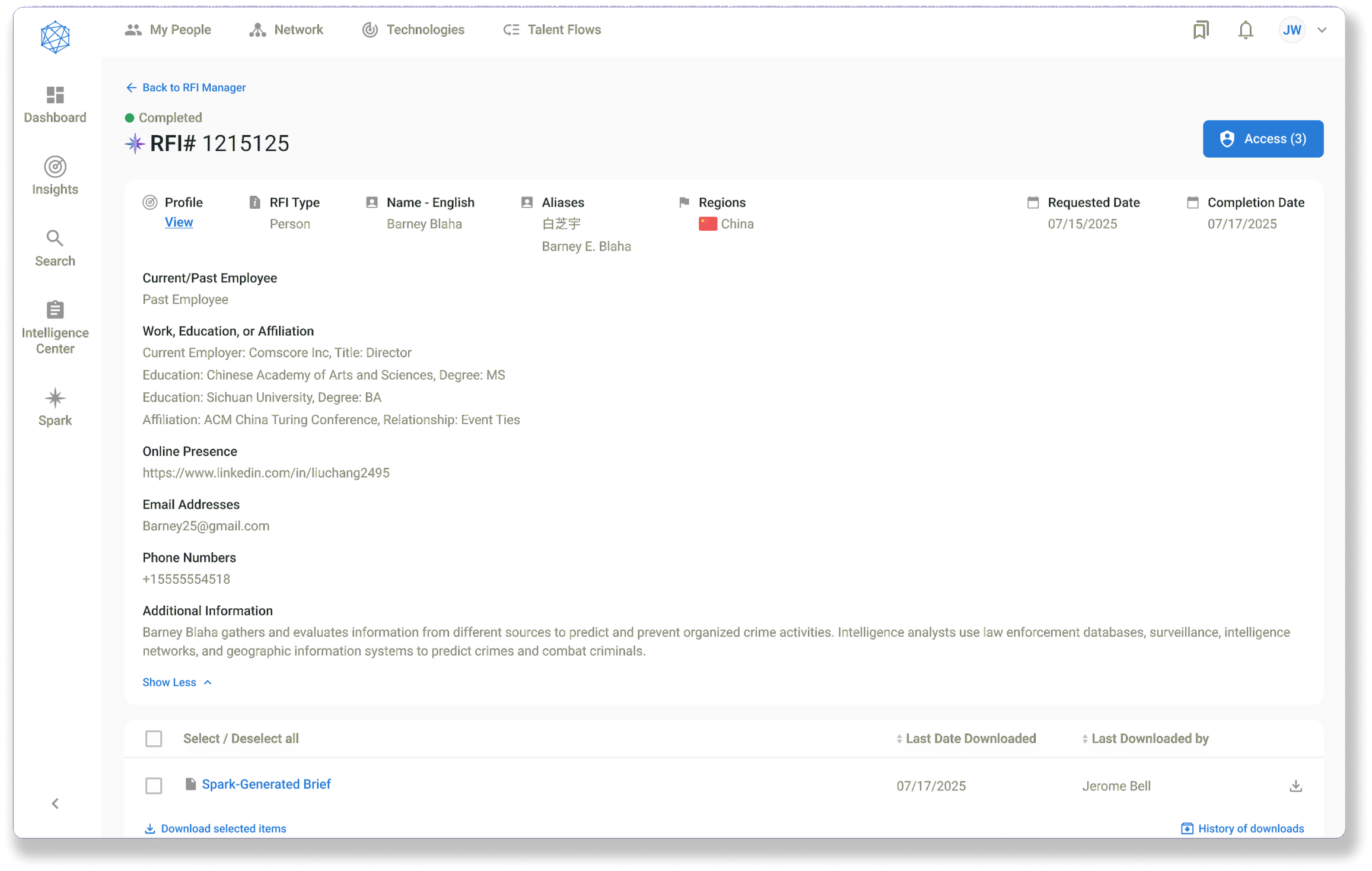
4. RFI Request Pages
Each request has its own RFI profile page that displays:
- •The information submitted by the user
- •Generated intelligence reports
- •Status and updates on the investigation
- •A link back to the related subject profile
When new intelligence is discovered, the associated profile is updated so investigators can continue their analysis.
The Design Choices
Spark-generated RFIs required Spark credits, which clients could purchase. To support this credit-based system, I designed several system states.
Credit visibility
Users could see:
- •Remaining Spark credits
- •When credits would be deducted
- •Estimated credit usage
Credit depletion states
If a user attempted to create a Spark RFI without credits, the interface:
- •Notified them that credits were exhausted
- •Suggested switching to analyst-assisted RFIs
- •Provided guidance on purchasing additional credits
Workflow alternatives
The interface clearly communicated the tradeoff between the Spark and analyst paths so the system stayed predictable and flexible. The form also allowed users to include additional identifiers and intelligence discovered during investigations.
The credit pricing model shifted twice during design, which forced us to rebuild the depletion state logic each time. The lesson: lock the underlying business constraint before detailed design begins.
The Outcome
Early beta results showed meaningful improvements:
- •Faster intelligence delivery: Reduced turnaround time from ~14 days to <24 hours
- •Reduced manual effort: ~45% decrease in time spent creating RFIs
- •Improved AI adoption: Clients hesitant to use AI decreased from ~60% to ~45%, with some client legal teams revising internal AI policies after seeing Spark surface risk their teams would have missed
- •New revenue opportunity: Spark-generated RFIs drove adoption of Spark credit purchases
- •Improved investigation workflow: Clients could now submit, track, and review RFIs directly in the platform
The result
Under 24 hours
Down from roughly 14 days, on every client request for information
45% faster to submit
Measured against the manual, out-of-product process it replaced
15 points of AI hesitancy removed
Client resistance to AI on investigation data fell from about 60% to about 45%
New revenue line
Spark-generated requests drove adoption of Spark credit purchases
Iterations & Next Steps
After the beta launch, I conducted additional user interviews to refine the workflow.
Future opportunities include:
- •Improving Spark-generated intelligence summaries
- •Adding more global organization identifiers
- •Providing clearer RFI progress tracking
- •Reducing response times further with incremental AI reporting
You’ve reached the end
Tell me what you’re building.
Pick a time. You leave with a price and a start date.